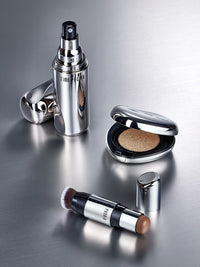


Choose a matte cushion foundation if you prefer a less reflective complexion and want to manage the appearance of shine. Choose a dewy cushion foundation if you prefer visible radiance and a fresher-looking surface. Neither finish is automatically better for your skin, provides more coverage, or lasts longer: those depend on the specific formula, your skin preparation, and how much you apply. If your T-zone gets shiny while your cheeks feel dry, you can also adjust application by area rather than treating your whole face the same. Start with the look you like, then test how it wears on your skin.
What Do Matte and Dewy Actually Mean?
Matte describes a surface that reflects less light. A modern soft-matte finish can look natural rather than flat; it may still let skin texture and dimension show. Dewy describes a more luminous surface that catches light, especially on the high points of the face. Dewy does not have to mean greasy, just as matte does not have to mean dry.
Finish is separate from coverage, which is how much the foundation visually evens skin tone. You can find a luminous formula with substantial coverage or a matte formula that you apply lightly. Wear is a third question: how well the look holds up through oil, movement, weather, and touch-ups. Do not assume the finish tells you the answer to either of those questions.
| What to compare | Soft-matte cushion | Dewy cushion |
|---|---|---|
| Look just after application | Less surface shine; softly diffused appearance | More light reflection and visible glow |
| If your T-zone becomes oily | Shine may become more noticeable later, even with a matte start | Glow and oil may become harder to distinguish; blotting may help |
| If your cheeks feel dry | Thin application and appropriate skin prep can help avoid emphasizing dry areas | A radiant look may be appealing, but the formula still needs to sit comfortably on dry patches |
| Touch-up approach | Blot first, then add only a little product where coverage has worn away | Preserve the glow where you like it; blot only the areas that look overly shiny |
These are practical tendencies, not promises about every product. Shade match, skin condition, and lighting can change how either finish appears.
Which Finish Fits Your Skin and Your Style?
If you have oily skin
A soft-matte cushion is a sensible first comparison if you dislike shine, especially across the forehead, nose, and chin. But oily skin still needs suitable skin care; trying to dry it out with harsh cleansing is not a makeup strategy. The American Academy of Dermatology's oily-skin guidance recommends gentle cleansing and moisturizing even when skin is oily. Apply foundation in a thin layer, then judge whether you actually need powder in the T-zone.
If you like a luminous finish, oily skin does not prohibit dewy makeup. You may simply prefer to keep the glow on the cheeks and manage the center of the face with blotting or a small amount of powder.
If you have dry skin
Dewy may be the look you gravitate toward, but a glowing finish cannot replace moisturizer or make flaky skin disappear. Prep dry areas with a moisturizer that feels comfortable on your skin and let it settle before you apply foundation. The AAD's moisturizer guide explains that skin type and degree of dryness should guide your moisturizer choice. If you prefer matte, you can still try it: use less product over dry patches and check the result in daylight.
If you have combination skin
Think in zones. You might apply a lighter layer over drier cheeks and build coverage only around the nose or on spots. With a dewy cushion, you can leave the cheeks luminous and lightly blot or set the T-zone. With a matte cushion, avoid repeatedly layering over dry areas simply to make the whole face look identical.
If your choice is mainly aesthetic
That is a perfectly good reason to choose a finish. A soft-matte base can give you a quieter, more diffused backdrop for bold lips or eyes. A dewy base can bring more light to a minimal makeup look. Neither is inherently more “natural”; the most natural-looking result is usually the one applied in an amount that suits your skin and the effect you want.
How Lumina and Utopia Compare
TimePhoria has two cushion examples with distinct finish goals. Timeless Lumina Matte Cover Cushion Foundation is listed as full coverage with a natural soft-matte finish and is positioned for people seeking less visible shine, particularly with oily or combination skin. Timeless Utopia Glow Perfection Cushion is listed as medium-to-full, buildable coverage with a radiant soft-blur glow. Its finish is intended for someone who wants more visible luminosity.
This comparison does not mean Lumina always looks better on oily skin or Utopia always looks better on dry skin. It means their starting looks and coverage profiles differ. A person with dry skin might prefer Lumina's softer reflection after careful prep; a person with oily skin might still choose Utopia's glow and selectively manage the T-zone. Compare shades and product details in the TimePhoria foundation collection, then consider a real-skin test if you can.
A Five-Minute Finish Test Before You Decide
If you can try both formulas, compare them under conditions that make the difference meaningful:
- Prepare both sides of your face the same way. Cleanse, moisturize as needed, and apply sunscreen before makeup. The AAD's recommended skin-care order places moisturizer and/or sunscreen before makeup.
- Use a shade that matches each side as closely as possible. A poor shade match can distract from the finish comparison.
- Tap on one thin layer with a clean puff. Do not build one side heavily while leaving the other sheer.
- Look in daylight after the formula settles. Notice light reflection on the cheeks, nose, and forehead—not just how the compact looks in the pan.
- Check again later. Compare comfort, shine, patchiness, and where you would actually want a touch-up. Take photos in similar light if you want a fairer reference.
Do not judge longevity from a single studio image or from a brand's maximum wear-time claim. Both can help you understand a product's intended look, but your own application and day will determine the useful comparison.
Common Mistakes When Choosing a Finish
- Treating matte as a synonym for full coverage. Decide how much tone-evening you want separately from how shiny the surface should look.
- Treating dewy as a synonym for hydration. A luminous appearance is not proof that a formula meets your skin's moisturizing needs.
- Choosing only by skin type. Preferences matter; adjust your prep and placement rather than following a rigid oily/matte or dry/dewy rule.
- Adding too much powder to fix the wrong finish. A light, localized setting step can help, but heavy powder may obscure the look you chose and emphasize texture.
- Comparing images in different light. Front lighting, window light, and flash can make the same base look very different.
Frequently Asked Questions
Is matte cushion foundation better for oily skin?
It may be a helpful starting point if you want to reduce the appearance of shine. It is not a guarantee that oil will never show through. Choose by the formula's feel and finish, then check how it wears on your own T-zone.
Is dewy cushion foundation always lower coverage?
No. Dewy describes reflected light, not pigment coverage. Utopia, for example, is positioned as medium-to-full and buildable, while Lumina is positioned as full coverage with a soft-matte finish.
Can I make a matte cushion look less flat?
Try a thinner layer and avoid powdering areas that do not need it. You can also keep the rest of your makeup more luminous. Do not rely on adding a thick second layer of foundation to change the finish.
Can I make a dewy cushion look less shiny?
Yes. Gently blot areas that become oily and, if needed, apply a small amount of setting powder only there. Leave the areas where you like the glow alone.
Which finish photographs better?
There is no universal winner. Flash, direction of light, skin preparation, and how much product you applied all affect the photo. Compare both finishes in the lighting where you expect to wear them.
The Bottom Line
Pick soft matte if you want a more diffused, less shiny base; pick dewy if you want a visibly light-catching one. Then evaluate coverage, shade, comfort, and wear as separate decisions. Lumina and Utopia give you two different starting points within the same cushion format. A thin, even application—and a real-life check a few hours later—will tell you more than a finish label alone.